
SI-augmented Digital Engineering, Modeling & Simulation

Make the whole enterprise make sense.

PALLC integrates authoritative models and data, engineering tools and simulations within one adaptively scalable, SI-augmented DEM&S environment. We automate model preparation and transformation, connect executable system architectures, and maintain traceability as requirements and configurations change.

Acquisition programs can compare design alternatives, identify interoperability shortfalls and focus test and evaluation. Exercise sponsors can examine courses of action through analytical wargaming, rehearse coordination in exercises, and assess participant performance against event objectives. Live, virtual and constructive (LVC) integration supports event execution. Speed from Rigor.

Watch the requirements-to-execution demonstration →

01 / Digital engineering

Maintain usable engineering models

Reduce manual reconciliation. Give engineering and acquisition participants a consistent basis for evaluating change.

The challenge
Requirements, models and technical records change faster than disconnected documents can be reconciled.
PALLC capability
PALLC connects mission needs to measurable requirements, authoritative models and source records, then maintains their relationships through a configuration-controlled digital thread.
Engineering outputs
Editable system models, source-to-model mappings, interface documentation and a configuration-controlled baseline.
Trace this capability

02 / Executable architectures

Evaluate integration before physical test

Expose interaction problems earlier and focus physical integration and testing on the configurations that matter.

The challenge
An architecture alone does not establish how interacting systems will behave under changing conditions.
PALLC capability
PALLC connects system models, software and simulators through explicit interfaces and DEVS coupling semantics. Controlled model execution and recurring V&V support integration and test planning as configurations change.
Engineering outputs
Executable model configurations, documented interfaces, requirements-linked test cases and V&V assessments supporting developmental and operational test objectives.
Trace this capability

03 / Planning · exercises · wargaming

Prepare and assess mission capability

Examine operational alternatives, identify shortfalls and refine plans and capability-development priorities.

The challenge
Technical performance must be understood alongside operational conditions, human decisions and coordination across the force.
PALLC capability
PALLC connects mission objectives, courses of action and assessment criteria to analytical wargames, exercises and LVC integration.
Engineering outputs
Scenario and exercise designs, executable simulations, measures of performance and effectiveness, and assessment findings.
Trace this capability

04 / Dynamical systems · computational physics

Focus computation and test

Concentrate analysis and measurements on high-impact factors. Compare alternatives with the resolution and confidence the decision requires.

The challenge
Interacting physical phenomena and uncertain inputs can change a design or mission outcome. Uniform model resolution does not answer every question efficiently.
PALLC capability
PALLC connects computational physics, sensitivity analysis and uncertainty quantification to the operating conditions and interactions that govern the decision.
Engineering outputs
Computational studies, model configurations, numerical verification, uncertainty assessments and test conditions.
Trace this capability

05 / Model reduction · digital twins

Connect prediction with physical systems

Carry useful physical behavior into repeated design evaluations and adaptive digital-twin applications.

The challenge
Repeated and time-sensitive evaluations need tractable models that remain relevant as physical conditions and configurations change.
PALLC capability
PALLC connects model reduction, predictive physics and observations within its SI-augmented DEM&S environment, with V&V matched to intended use.
Engineering outputs
Integrated reduced models, prediction-to-observation comparisons and defined model-update interfaces.
Trace this capability

06 / Cross-cutting SI integration

Make SI usable in the engineering environment

Shorten the interval from technical information to usable models and checked outputs within the customer’s environment.

The challenge
Access to a frontier model alone does not connect enterprise data, persistent context, engineering tools and permitted execution.
PALLC capability
PALLC develops model-transformation, code-generation and analysis workflows around authorized SI services, protected data and engineering interfaces. Human review, software testing and traceable model configurations govern integration of generated outputs.
Engineering outputs
Integration architecture, domain mappings, tool adapters, controlled execution, model and version provenance, and performance evaluations against representative engineering tasks.
Trace this capability

Explore the connected model

Follow the engineering logic.

33 concepts52 directed relationships

Trace how a customer objective connects to engineering capabilities, outputs and decisions. Select a step to inspect its relationships and sources, or find a connection of your own.

Mission

Mission objectives

Desired ends and conditions that guide planning, capability development and assessment.

Outgoing relationships

Incoming relationships

No relationships in this direction.

Concept references

Mission

Operational conditions

The environment, constraints and interactions under which a capability must perform. These define relevant scenarios and test conditions.

Outgoing relationships

Incoming relationships

No relationships in this direction.

Concept references

Mission

Mission tasks

Activities required to accomplish the mission. Task standards provide a basis for measures of performance.

Outgoing relationships

Incoming relationships

Concept references

Architecture

Requirements

Specified needs and constraints translated into criteria for design, integration and verification.

Outgoing relationships

Incoming relationships

Concept references

Architecture

Authoritative models & data

Controlled engineering information that supplies a trusted basis for development, analysis and decisions across the lifecycle.

Outgoing relationships

Incoming relationships

No relationships in this direction.

Concept references

Architecture

Semantic model

An explicit model of entities, meanings and relationships that connects information across documents, architectures, software and simulations.

Outgoing relationships

Incoming relationships

Concept references

Architecture

System architecture

A model of system elements, their responsibilities and relationships. It connects requirements to the interfaces and behavior needed for integration.

Outgoing relationships

Incoming relationships

Concept references

Architecture

Interface definitions

Contracts for exchanged information and behavior, including ownership, units, reference frames, events and time where applicable.

Outgoing relationships

  • govern

    Executable system integration
    Relationship basis

    Interface definitions → govern → Executable system integration

    Exchange contracts and coupling semantics establish how constituent models and software may interact.

    PALLC engineering application

Incoming relationships

  • System architecture → defines → Interface definitions

    Trace from System architecture
    Relationship basis

    System architecture → defines → Interface definitions

    Model structure identifies the interfaces that must be specified for constituent systems to interact.

    PALLC engineering application

Concept references

Output

Controlled model baseline

Versioned models, configurations and interface definitions that can be reviewed, updated and used consistently by engineering and acquisition participants.

Outgoing relationships

Incoming relationships

Concept references

Capability

Model transformation

PALLC develops mappings and adapters that connect source information, system models and engineering tools while checking what the transformation preserves.

Outgoing relationships

Incoming relationships

Concept references

Capability

Executable system integration

PALLC connects constituent models and software through defined interfaces and coupling semantics to evaluate combined system behavior.

Outgoing relationships

  • configures

    Simulation execution
    Relationship basis

    Executable system integration → configures → Simulation execution

    Coupled models are assembled into executable configurations with explicit time and state behavior.

    PALLC engineering application

Incoming relationships

  • Interface definitions → govern → Executable system integration

    Trace from Interface definitions
    Relationship basis

    Interface definitions → govern → Executable system integration

    Exchange contracts and coupling semantics establish how constituent models and software may interact.

    PALLC engineering application

Concept references

Capability

Simulation execution

Configured models run with explicit inputs, state transitions and time behavior so interactions and changes can be examined.

Outgoing relationships

Incoming relationships

Concept references

Architecture

Digital thread

Connections among authoritative data, models and analysis results that support information flow and updates throughout the lifecycle.

Outgoing relationships

Incoming relationships

Concept references

Output

Digital engineering artifacts

Model-derived views, interface documentation, software and analytical results prepared for the customer’s engineering environment.

Outgoing relationships

Incoming relationships

Concept references

Assessment

Verification & validation

For models and simulations, verification assesses implementation and data against the conceptual description and specifications. Validation assesses real-world representation for the intended use. Documented V&V supports the designated authority’s separate accreditation decision.

Outgoing relationships

Incoming relationships

Concept references

Mission

Courses of action

Alternative ways to accomplish the mission, developed and analyzed against objectives, constraints and evaluation criteria.

Outgoing relationships

  • are examined through

    Exercises & analytical wargaming
    Relationship basis

    Courses of action → are examined through → Exercises & analytical wargaming

    COA analysis uses wargaming to examine actions, reactions and consequences against evaluation criteria.

    Planning concept

Incoming relationships

  • Mission objectives → guide development of → Courses of action

    Trace from Mission objectives
    Relationship basis

    Mission objectives → guide development of → Courses of action

    Courses of action are developed to accomplish the mission and satisfy its objectives.

    Planning concept

  • Plan refinement → revisits → Courses of action

    Trace from Plan refinement
    Relationship basis

    Plan refinement → revisits → Courses of action

    Refinement may require revising or developing courses of action.

    Planning concept

Concept references

Capability

Exercises & analytical wargaming

PALLC develops scenarios, decision points and assessment designs to examine courses of action, coordination and operational employment.

Outgoing relationships

Incoming relationships

  • Operational conditions → frame → Exercises & analytical wargaming

    Trace from Operational conditions
    Relationship basis

    Operational conditions → frame → Exercises & analytical wargaming

    Scenarios make operating conditions and constraints explicit for participants and assessment.

    PALLC engineering application

  • LVC integration → supports → Exercises & analytical wargaming

    Trace from LVC integration
    Relationship basis

    LVC integration → supports → Exercises & analytical wargaming

    Integrated participants and simulations support scenario execution and exercise objectives.

    PALLC engineering application

  • Courses of action → are examined through → Exercises & analytical wargaming

    Trace from Courses of action
    Relationship basis

    Courses of action → are examined through → Exercises & analytical wargaming

    COA analysis uses wargaming to examine actions, reactions and consequences against evaluation criteria.

    Planning concept

Concept references

Capability

LVC integration

PALLC connects live, virtual and constructive participants and simulations through agreed interfaces, scenario conditions and assessment requirements.

Outgoing relationships

Incoming relationships

Concept references

Output

Physical test & sensor observations

Measurements from the physical system, retained with sensor provenance, configuration, units and conditions for model comparison and updates.

Outgoing relationships

Incoming relationships

Concept references

Assessment

Measures of performance

Criteria used to assess whether assigned tasks have been accomplished to the required standard.

Outgoing relationships

Incoming relationships

Concept references

Assessment

Measures of effectiveness

Criteria used to assess changes in conditions and progress toward objectives. They address the effect of activities, beyond task completion alone.

Outgoing relationships

Incoming relationships

Concept references

Assessment

Mission assessment

Interpret performance and effectiveness in context to identify progress, shortfalls and implications for plans or capability development.

Outgoing relationships

Incoming relationships

Concept references

Capability

Dynamical systems & computational physics

PALLC models physical behavior across interacting domains: motion and orbital dynamics, flow, reacting and ionizing gases, thermochemistry and electromagnetic phenomena. The engineering question determines the model and resolution.

Outgoing relationships

Incoming relationships

  • Operational conditions → define cases for → Dynamical systems & computational physics

    Trace from Operational conditions
    Relationship basis

    Operational conditions → define cases for → Dynamical systems & computational physics

    A physical model must represent the operating conditions and interactions relevant to its intended use.

    PALLC engineering application

Concept references

Assessment

Uncertainty & sensitivity analysis

Evaluate how uncertain inputs, model assumptions and numerical error affect the quantities and decisions that matter. Identify where added resolution, observations or physical tests are useful.

Outgoing relationships

Incoming relationships

Concept references

Capability

Model order reduction

PALLC integrates reduced models for repeated and time-sensitive evaluations, checking the retained behavior against the application’s requirements.

Outgoing relationships

  • supports repeated evaluation within

    Adaptive digital twins
    Relationship basis

    Model order reduction → supports repeated evaluation within → Adaptive digital twins

    Qualified reduced models can support repeated evaluation when retained accuracy and total computational cost meet the application requirements.

    PALLC engineering application

Incoming relationships

  • Dynamical systems & computational physics → provide models for → Model order reduction

    Trace from Dynamical systems & computational physics
    Relationship basis

    Dynamical systems & computational physics → provide models for → Model order reduction

    Detailed models supply the behavior and reference evaluations used in developing and assessing reduced models.

    PALLC engineering application

Concept references

Capability

Adaptive digital twins

Connect predictive models with measurements and configuration changes so model updates can support continuing assessment of a physical system.

Outgoing relationships

Incoming relationships

Concept references

Output

Test conditions & criteria

Conditions, configurations, quantities and acceptance criteria chosen to evaluate requirements and the intended use of the system or model.

Outgoing relationships

Incoming relationships

Concept references

Capability

Frontier SI integration

PALLC develops SI-assisted model transformation, code generation and analysis around authoritative information, persistent context and engineering tools. Generated software requires review and testing; model, version and significant dataset records support traceability.

Outgoing relationships

Incoming relationships

Concept references

Architecture

Authorized execution environment

Customer-authorized SI services, data protections, network boundaries and tool permissions determine where and how SI-assisted engineering can execute. Cybersecurity authorization remains with the designated authority.

Outgoing relationships

Incoming relationships

No relationships in this direction.

Concept references

Decision

Engineering & acquisition decisions

Use connected models and assessments to select a design, prioritize integration, define a test or revise a development plan. The customer retains the decision authority.

Outgoing relationships

Incoming relationships

Concept references

Decision

Plan refinement

Use assessment findings to refine assumptions, courses of action, coordination and subsequent planning.

Outgoing relationships

  • revisits

    Courses of action
    Relationship basis

    Plan refinement → revisits → Courses of action

    Refinement may require revising or developing courses of action.

    Planning concept

Incoming relationships

Concept references

Output

Simulation results

Predicted behavior produced by a model under recorded inputs and configurations. These results remain distinct from independent physical measurements.

Outgoing relationships

Incoming relationships

Concept references

Output

Exercise observations

Recorded participant decisions, task performance and scenario outcomes. The assessment retains whether each observation came from live activity, a virtual participant or a constructive model.

Outgoing relationships

Incoming relationships

Concept references

Model development, integration and V&V

SI-augmented Digital Engineering, Modeling & Simulation.

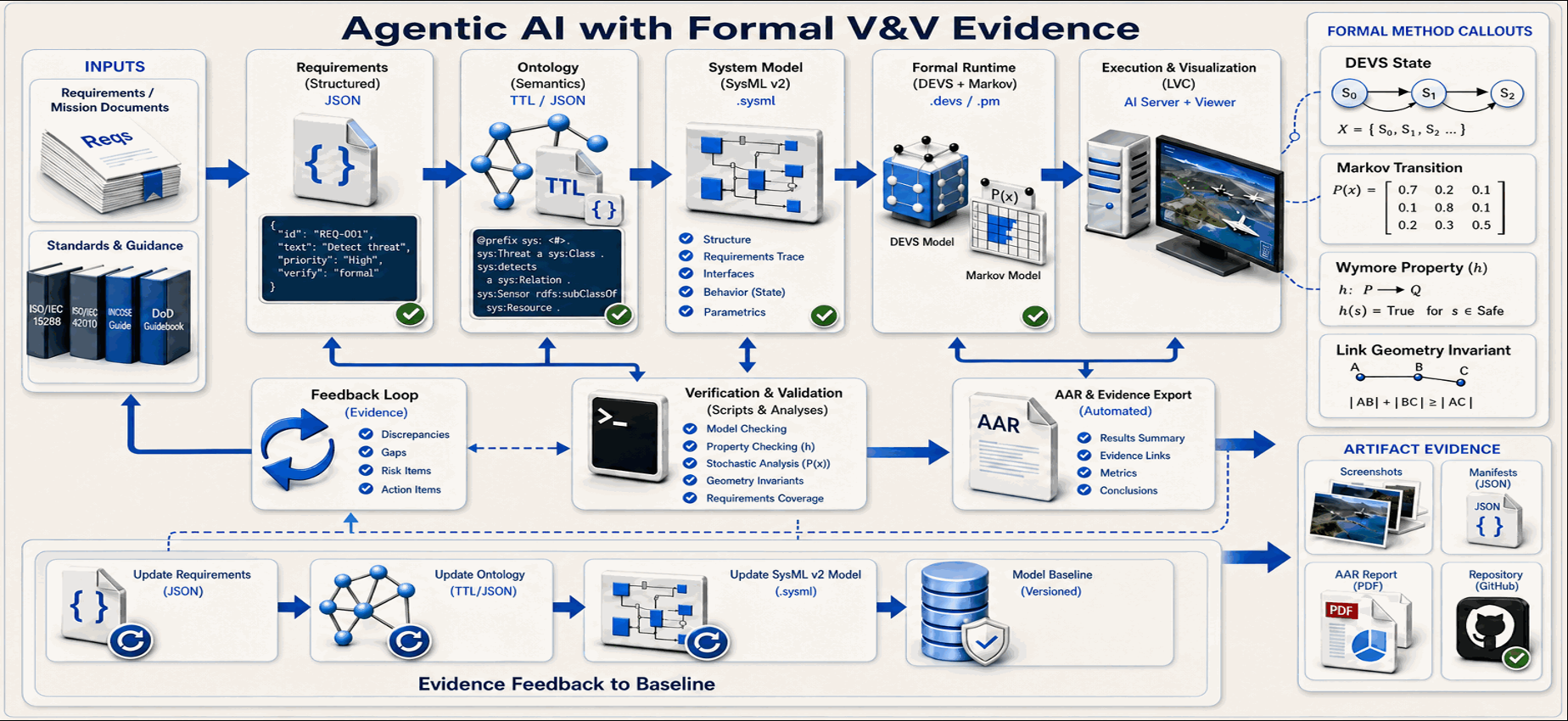
Executable-architecture workflow connecting requirements, ontology, a SysML system model, formal runtime and LVC execution. Verification and validation, after-action findings and feedback inform updates to requirements, models and the versioned baseline.
One executable-architecture workflow within PALLC’s broader SI-augmented DEM&S approach. Verification, validation and assessment inform the recurring feedback cycle.
Explore executable architectures

Policy and doctrine

A common engineering and operational language.

Mission objectives guide requirements, integration priorities and assessment criteria. PALLC connects authoritative models and data with executable architectures, continuous verification and validation, and user feedback to accelerate capability development.

DoDI 5000.97 provides the digital engineering foundation. DoDI 5000.61 ties model credibility to intended use through V&V and a separate accreditation decision. DoWI 8430.01 connects software delivery to mission outcomes, integrated T&E and accountable use of development tools. AFDP 5-0 frames planning and course-of-action analysis; JP 3-0 distinguishes task performance from progress toward mission objectives.

For customer programs, this means requirements-linked tests, controlled model and software configurations, and results that inform engineering, acquisition and operational decisions. Select a relationship to inspect its rationale and source.

  1. Policy

    DoDI 5000.97 · Digital engineering

    21 December 2023 · §§3.1–3.2, pp. 8–9

    Authoritative models and data; development, verification, validation and configuration management; integration across the acquisition lifecycle.

  2. Policy

    DoDI 5000.97 · Digital threads and twins

    §3.2.b, pp. 12–13

    Connect authoritative data and models across the lifecycle. Use models, observations and collected data to inform digital twins and engineering decisions.

  3. Policy

    DoDI 5000.61 · M&S verification, validation and accreditation

    17 September 2024 · §§3.1–3.3; glossary, pp. 7–11

    Plan V&V around intended use, model and data credibility, and uncertainty. Document results to support the designated authority’s accreditation decision.

  4. Policy

    DoWI 8430.01 · Accelerated Mission Software

    8 September 2026 · §§1.2.a, 3.2–3.3, pp. 4–5, 13–16

    Connect mission outcomes to measurable requirements, modular architectures, continuous delivery and user feedback.

  5. Doctrine

    AFDP 5-0 · Planning

    22 January 2025 · chapters 3, 6–8

    Frame the problem, establish objectives, develop and analyze courses of action, compare alternatives and refine the plan.

  6. Doctrine

    JP 3-0 · Joint Campaigns and Operations

    Chapter II · assessment, pp. II-9–II-11

    Measures of performance concern task accomplishment. Measures of effectiveness concern changes in conditions and progress toward objectives.

Explore PALLC

PALLC demonstration