Acquisition and design
Compare system architectures and design alternatives using the same requirements, model configurations and decision criteria.

SI-AUGMENTED DEM&S
Physics-based prediction, observations and model updates connect engineering analysis to the next decision.
PALLC / DIGITAL ENGINEERING, MODELING & SIMULATION
We connect computational physics, model reduction and observations in adaptive digital twins. A DEVS engine composes model behavior into executable systems. SI assists preparation, analysis and review, while a digital thread connects requirements, configurations and findings across the engineering lifecycle.
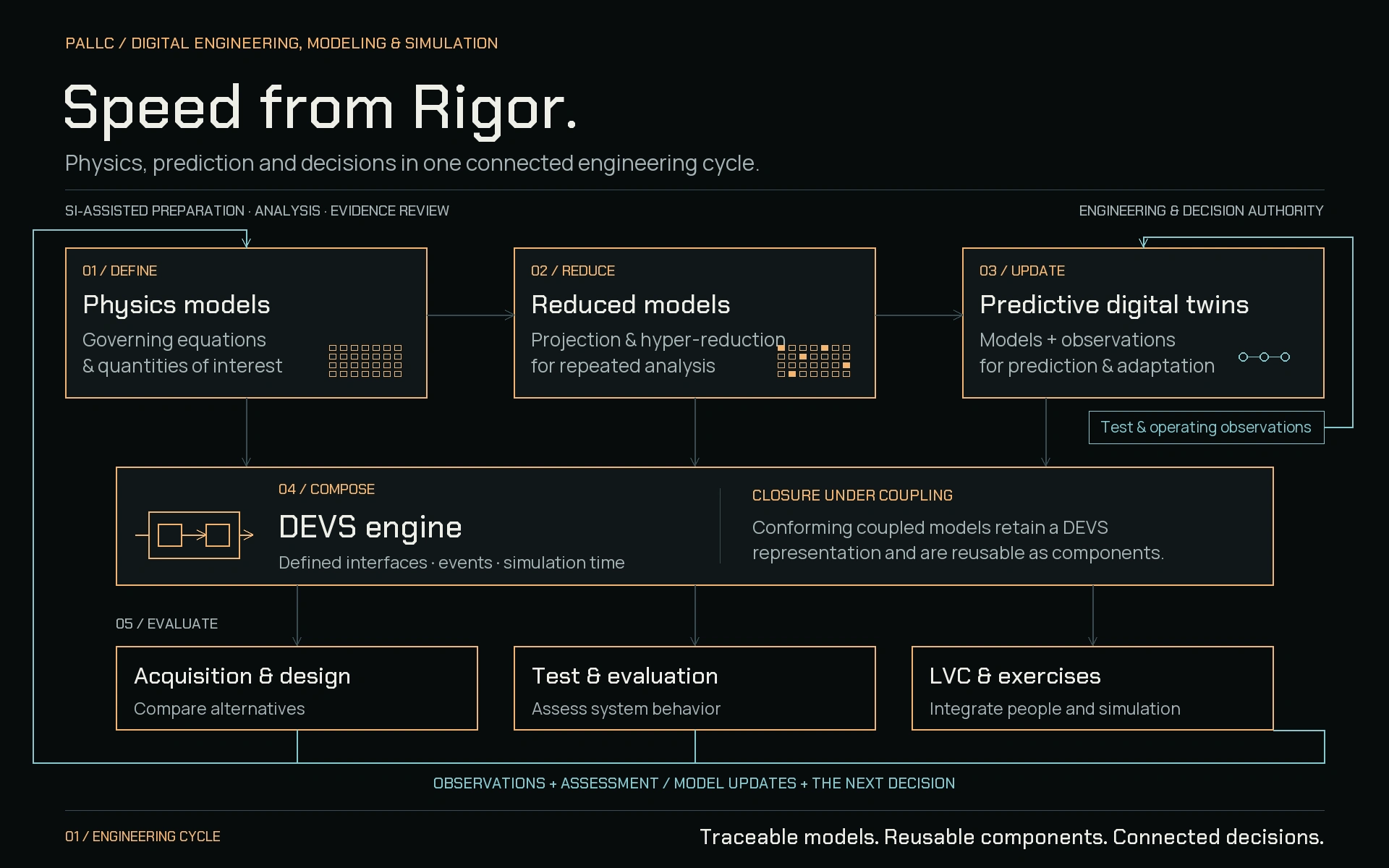
Connect mission objectives and system requirements to operating conditions, quantities of interest and decision criteria.
Build reduced-order models from detailed physics. Hyper-reduction reduces the nonlinear evaluations needed for repeated analysis.
Use test and operating observations to update the twin’s state, parameters or model selection and predict the next response.
We leverage a DEVS engine to couple model behavior, exchange events and coordinate simulation time.
Compare alternatives in acquisition, test and evaluation, and live, virtual and constructive environments for training and exercises.
Carry assessment into the next model configuration, design decision or test. Reassess the analyses affected by each change.
Reusable models. Focused reassessment. We shorten engineering cycles by reusing computational components, accelerating repeated analysis and automating repeatable work. Verification, validation and uncertainty assessment accompany model development and updates for the intended decision.
SYSTEMS THEORY / MODEL COMPOSITION
Discrete Event System Specification (DEVS) defines model states, transitions, events and time advance. Closure under coupling means a conforming coupled model has an equivalent atomic DEVS representation. A composed system can therefore become a component in a larger model hierarchy.
We use that foundation to combine physical models, system behavior and participant interactions. Reduced models accelerate computations inside components; the DEVS engine coordinates their event exchange and simulation time. Defined adapters connect continuous physics and external systems through explicit units, interfaces and timing.
Explore LVC integrationACQUISITION / T&E / LVC
Compare system architectures and design alternatives using the same requirements, model configurations and decision criteria.
Use predicted behavior and uncertainty to focus test conditions, compare observations and investigate discrepancies.
Connect system behavior and participant decisions in LVC environments. Carry event observations into assessment and the next exercise.