Abstract
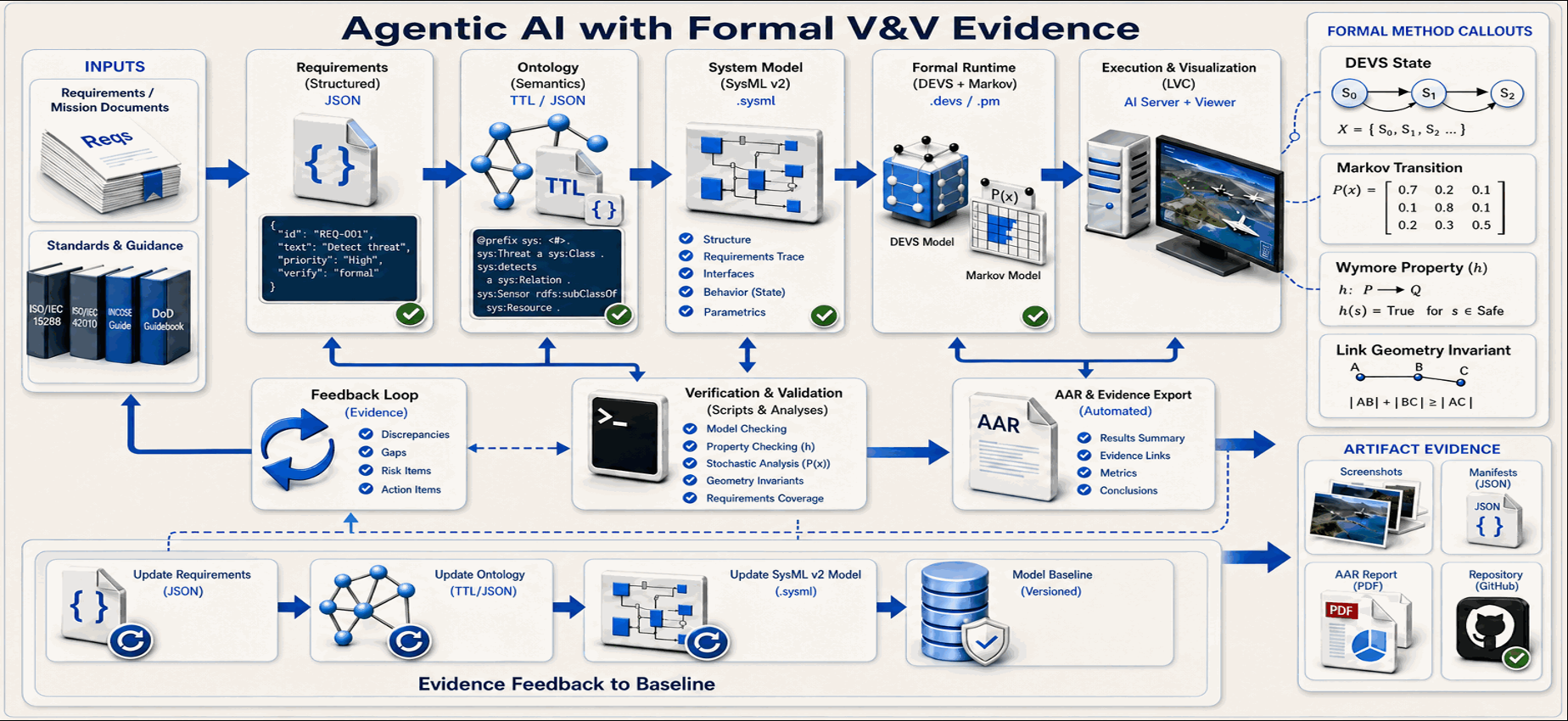
The digital thread remains fragmented in practice: requirements, architectures, models, and verification evidence are exchanged through documents and manual reconciliation rather than machine-verifiable relationships, and Modeling & Simulation (M&S) therefore functions as a downstream report about the system rather than the system's authoritative executable representation. We present an end-to-end methodology that makes the architecture executable, so that running it is the act that generates verification evidence. The methodology composes a formal operational ontology, a SysML v2 model of record, a closure-preserving transformation into a coupled Parallel-DEVS federation, and agentic-AI acceleration under human-in-the-loop governance, closed by a federation data spine that returns execution evidence to the model of record. The primary contribution is methodological: this evidence-return loop, governed by machine-readable provenance and structural human review, and the treatment of immersive 3D as a peer subscriber to the executed state—so what stakeholders see is authoritative by construction rather than a separately scripted visualization. The formal core is deliberately light and supports, rather than headlines, that contribution: we reprove two classical DEVS results—coupled Parallel-DEVS is equivalent to a resultant atomic DEVS (closure under coupling), and a closed hierarchical network is legitimate under a positive minimum time-advance—give a structural-induction characterization of the architecture and its required infrastructure, and verify that the architecture-to-simulation transformation is interface-preserving (a structure bijection of the port-keyed connection relation onto the coupling relation; a formal-hygiene guarantee that the pipeline neither invents nor drops couplings, near-definitional on that relation, not a deep theorem). The transformation step itself follows the DoDAF/UML-to-DEVS executable-architecture line (eUDEVS/DUNIP); our novelty is the governed loop around it, not the mapping. The methodology is demonstrated on a notional five-domain collective-defense scenario, and its claims are reported against a four-tier evidence scorecard that separates results proved in this work from demonstration observations and prospective, testable predictions. Immersive 3D is treated as a peer subscriber to the executed state, so what stakeholders see is authoritative by construction.
Collaboration at MODSIM World
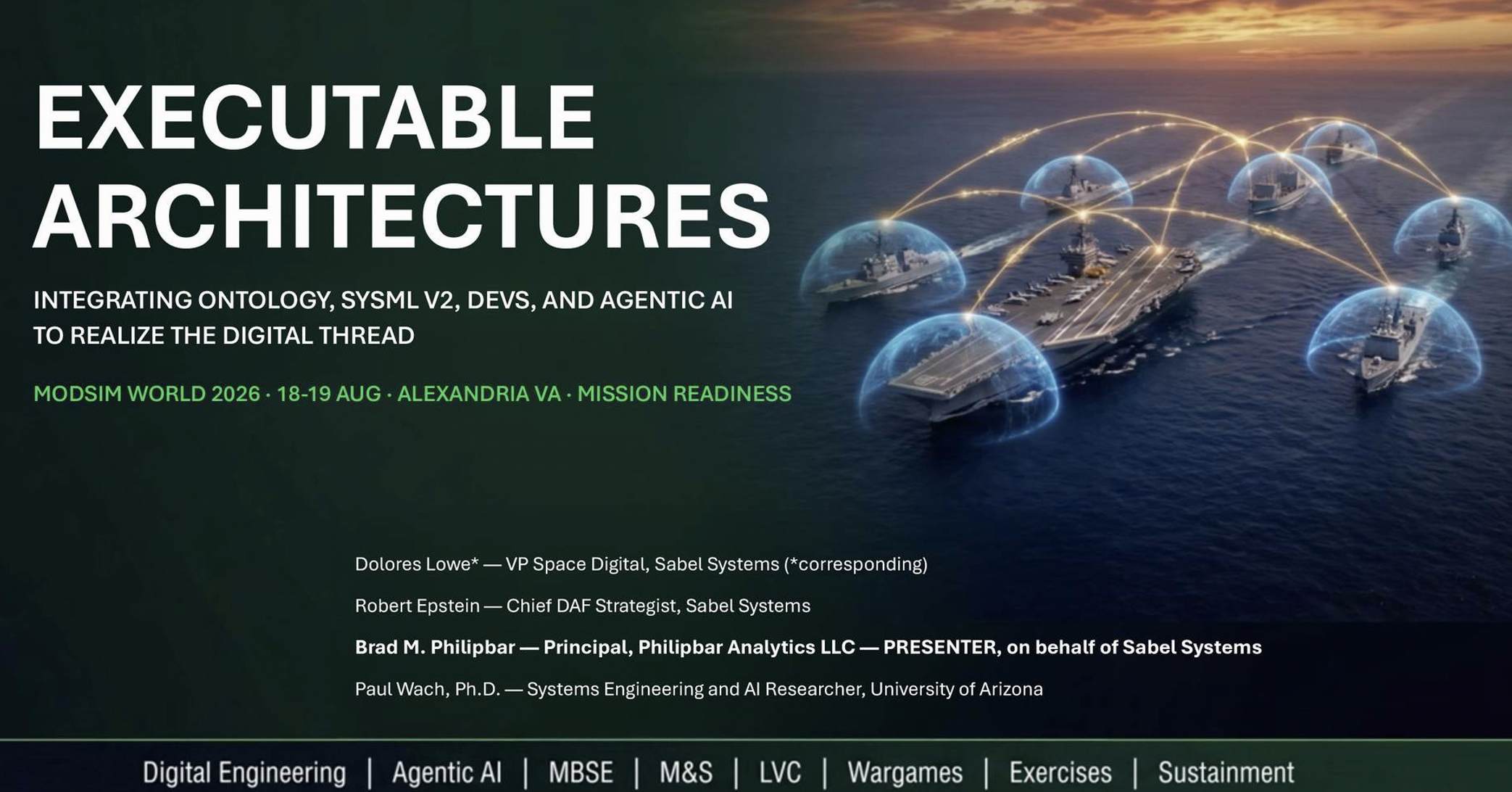
PALLC, Sabel Systems and the University of Arizona, including Dr. Paul Wach, contributed to the collaborative research shared at MODSIM World 2026. NTSA and government senior leaders supported the exchange and helped advance an integration-focused approach to modeling and simulation.
This type of collaborative R&D is rare. Democratizing complex systems is difficult—and foundational to systems integration at scale. This white paper shares research and development intended to advance that approach, connecting engineering models, executable simulation and the evidence needed to assess their integration.