Abstract
We present a System Entity Structure methodology for orchestrating large language model agents as a Discrete Event System Specification coupled model, with verification and validation carried out through the DEVS hierarchy of system specifications and its morphisms. The central claim is that an agent workflow should be specified, pruned, executed, and verified in one system-theoretic chain rather than assembled as an informal action graph. Building on MetaSES, every component is one Agent class specialized by role; coordination is port coupling; and a concrete architecture is obtained by SES pruning followed by a transform to a simulatable DEVS coupled model. We implement the full chain from MetaSES to free digraph to pruning to DEVS, then execute a representative systems-engineering task using LLM-backed atomic DEVS agents grounded by offline sentence embeddings over a technical corpus.
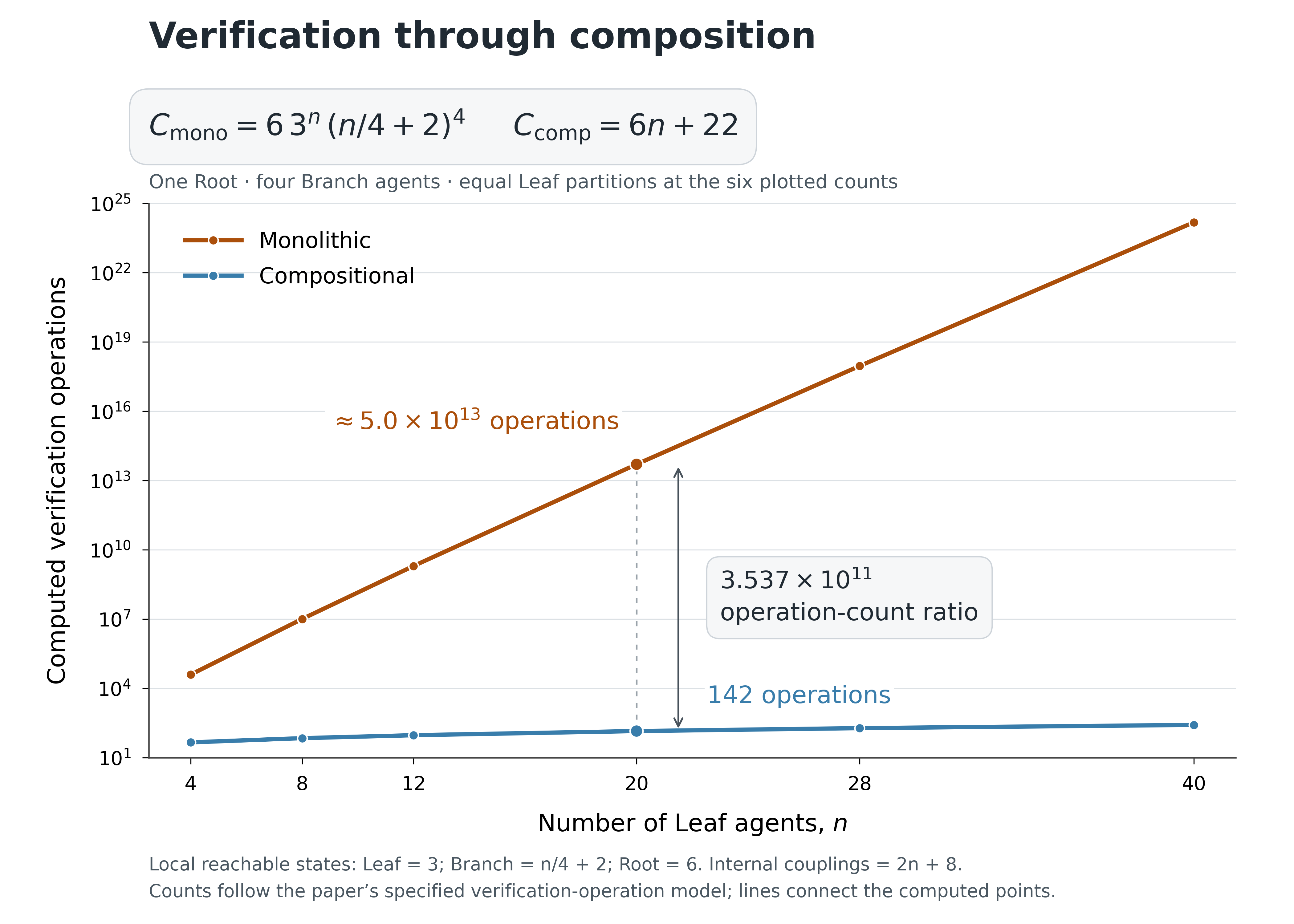
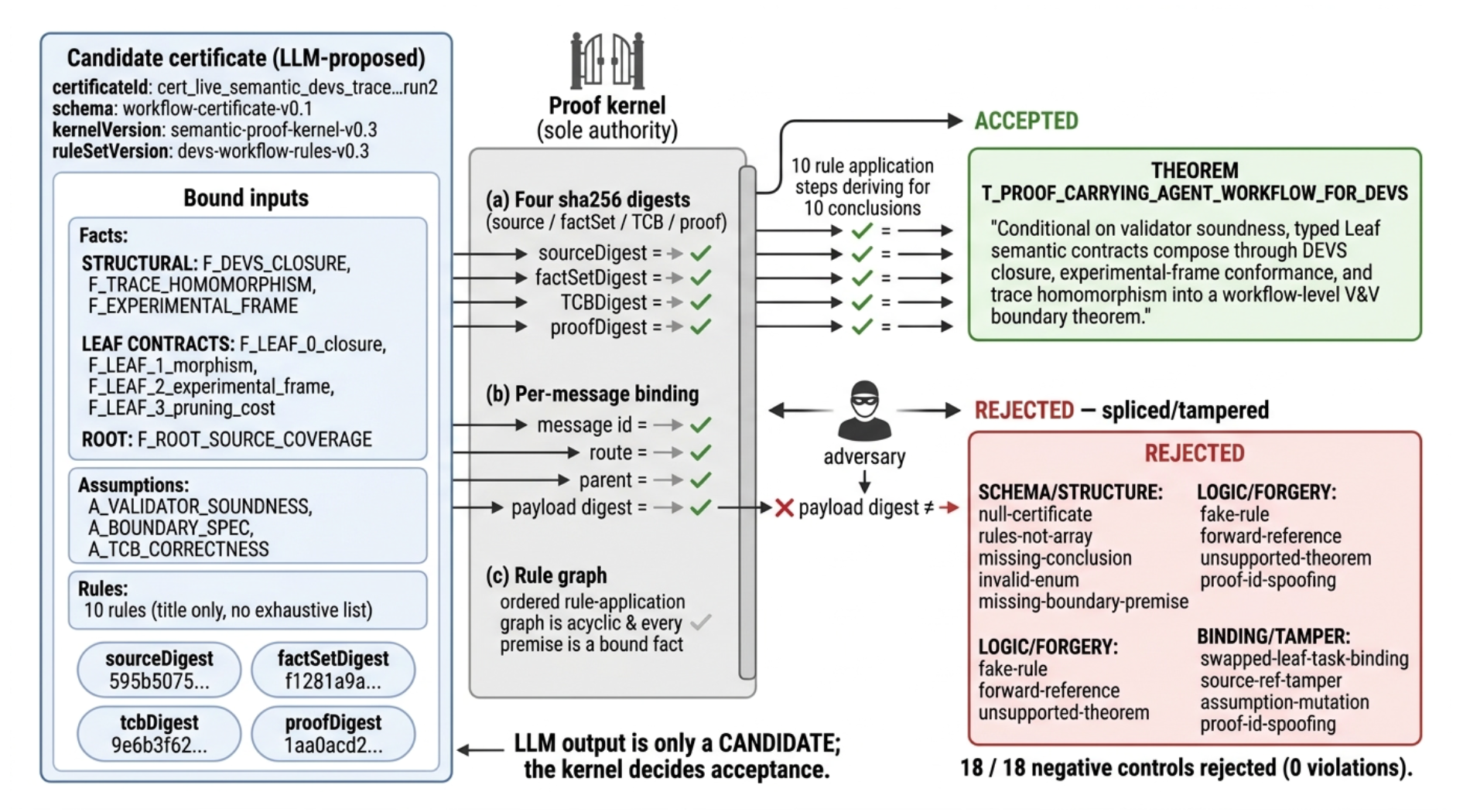
DEVS supplies the verification mechanism. Closure under coupling gives the Network-of-Systems model a behaviorally equivalent atomic realization; the recorded trace is an exact homomorphic image of the coupling structure under an experimental frame; WySE metrics quantify pruning's footprint on a graph-Laplacian diffusion surrogate; and closure licenses compositional verification in place of flattened product-state checking, yielding a computed reduction of more than 350 billion verification operations at 20 leaf agents. A payload-bound proof-carrying workflow further restricts semantic authority: LLMs may generate typed records or candidate certificates, but validators and the proof kernel decide acceptance. The result is verifier-relative for the specified artifact class, not a claim of unrestricted LLM semantic correctness.