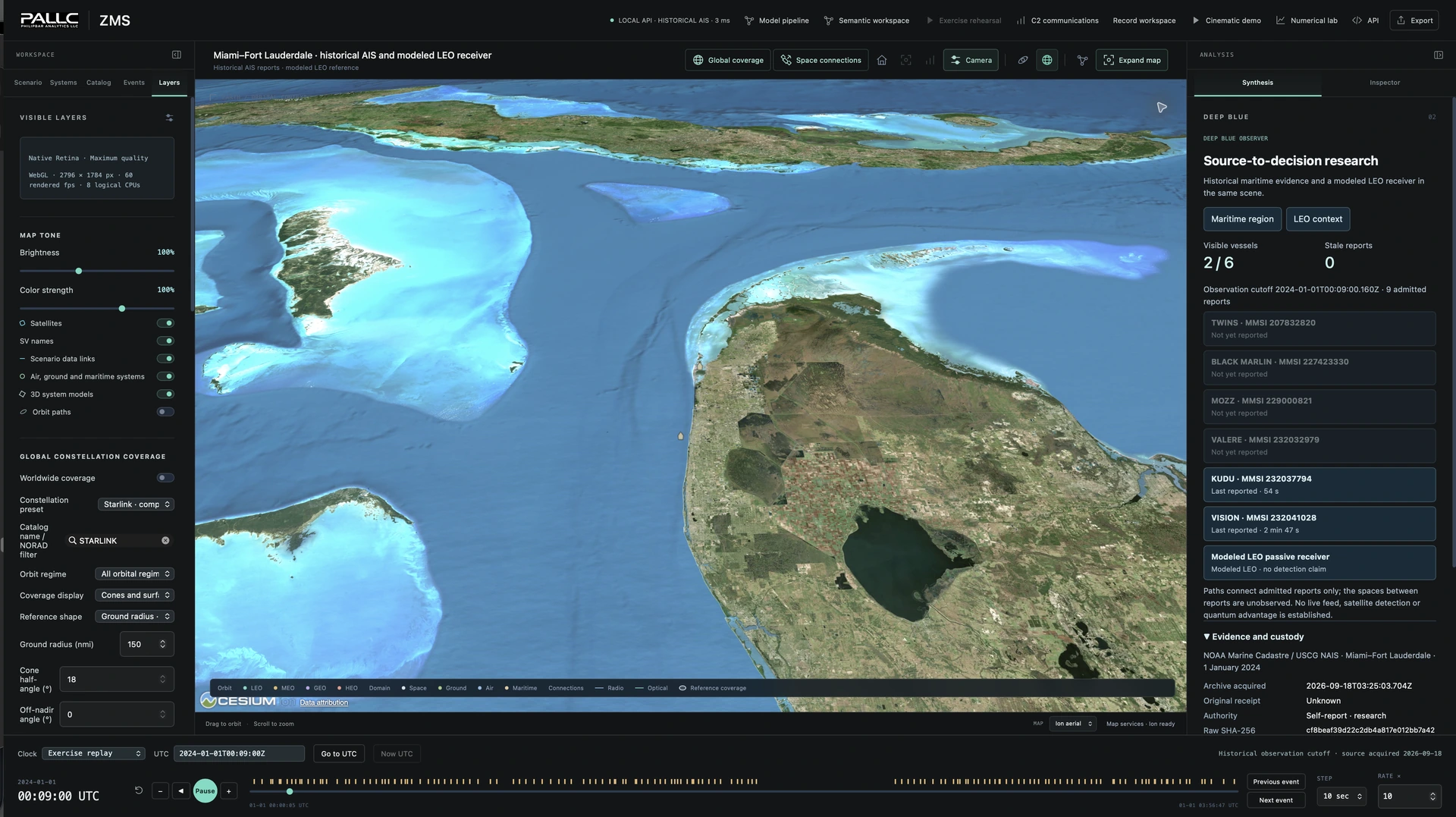
ZMS connects model execution, scenario timing and geospatial context so engineers and analysts can examine how systems interact. Aircraft, maritime tracks, ground nodes and orbital references share a view with source observations and information-delivery records.
Scenario preparation and replay support controlled comparisons, exercise injects and after-action review. Observation age, processing delays and retained decision histories help explain how the information available at a particular time affects a result.
Computational-physics views connect fields and cell identifiers to physical units, saved solver states and numerical checks. The four-case demonstration includes bow-shock convergence, reacting-air flow, electromagnetic verification and thermochemistry.