
Capabilities

Space and mission analysis

Assess how orbital dynamics, sensing and information delivery affect mission performance.

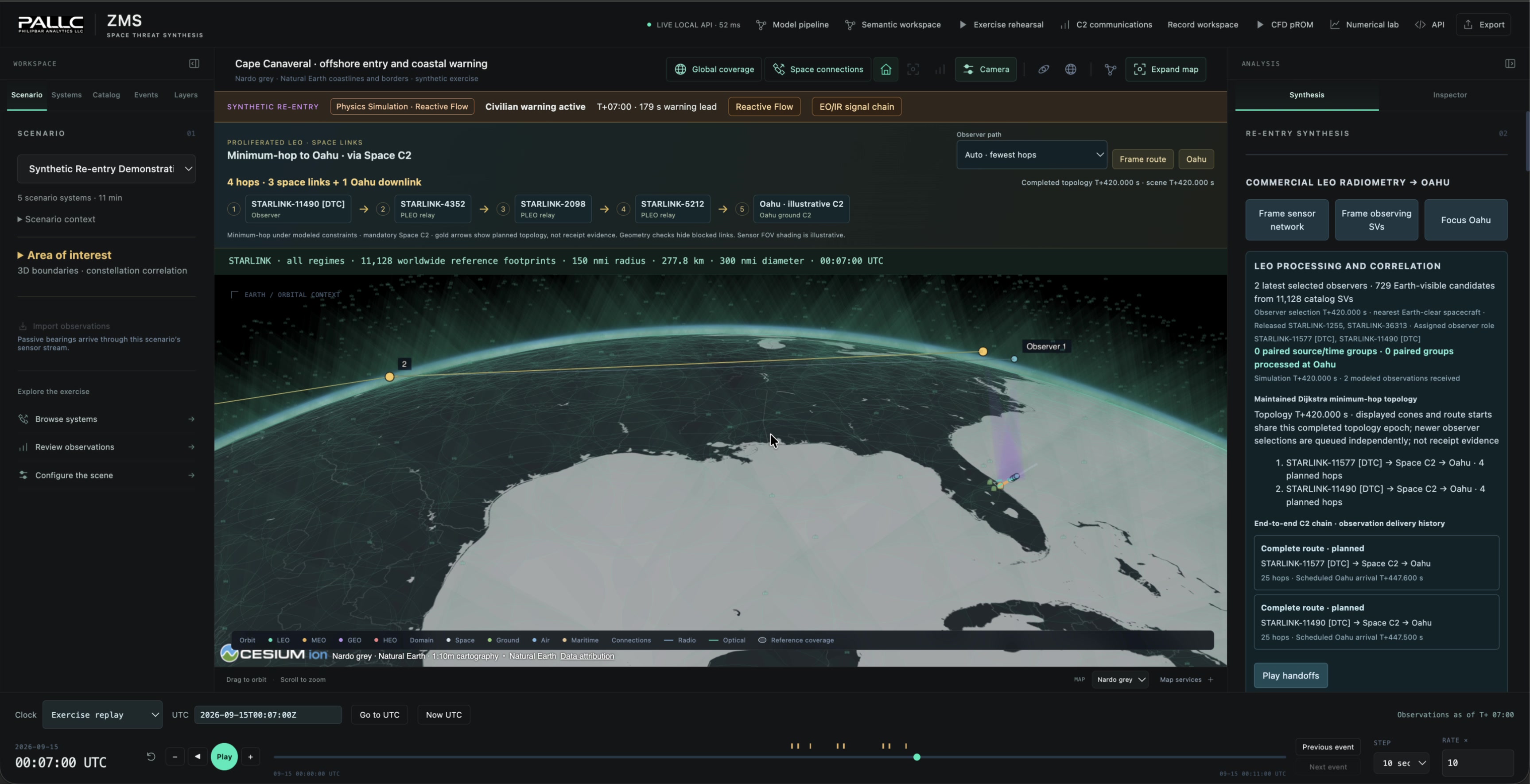
ZMS shows changing LEO relay connections to Oahu
Adaptive LEO handoff / minimum-hop routing at the displayed scenario time.

ZMS research prototype

Geometry, information paths and mission time.

Scenario analysis connects orbital and ground-system relationships to the timing of mission decisions.

Engineering scope

PALLC connects orbital and vehicle dynamics with observer geometry, sensing and command-and-control dependencies. Mission objectives define the observations, coverage, timing and information exchanges that the analysis must address.

Line of sight, radiometric and RF calculations, processing schedules and communication delays shape the modeled information available to each participant. Uncertainty and sensitivity studies help identify which parameters drive differences between alternatives.

ZMS connects physical source states to observations, relay routes and scenario time. Controlled comparisons and replay support architecture trades, test planning and assessment of information delivery across the mission thread.

PHYSICS / OBSERVATION / DELIVERY

Connect the calculation to the mission.

Assess how observer geometry, visibility, processing and communication affect when information reaches its user. Scenario comparisons retain the source state and distinguish physical time from mission time.

Explore the connected ZMS workflow

Explore PALLC

PALLC demonstration